Tag Archives: architecture

black + white house.

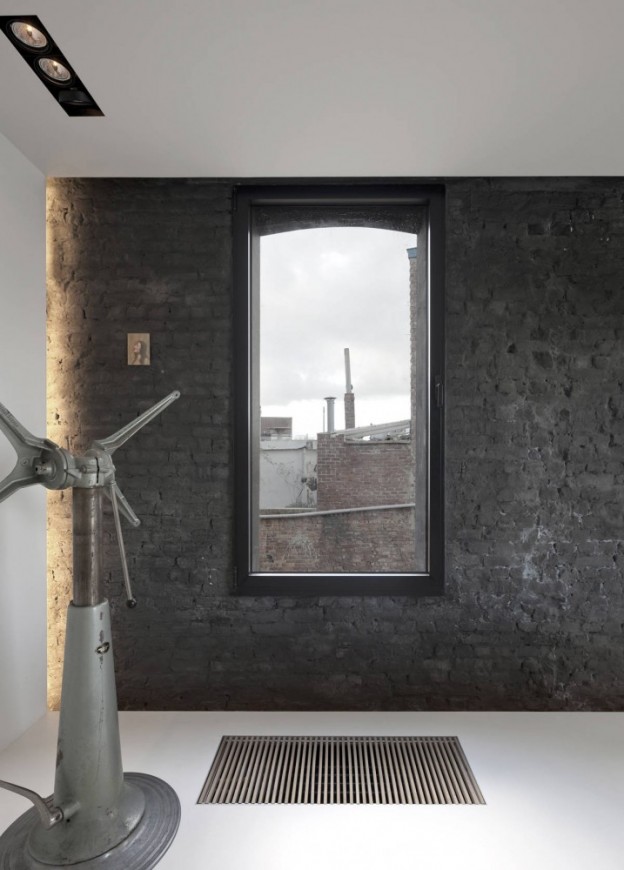
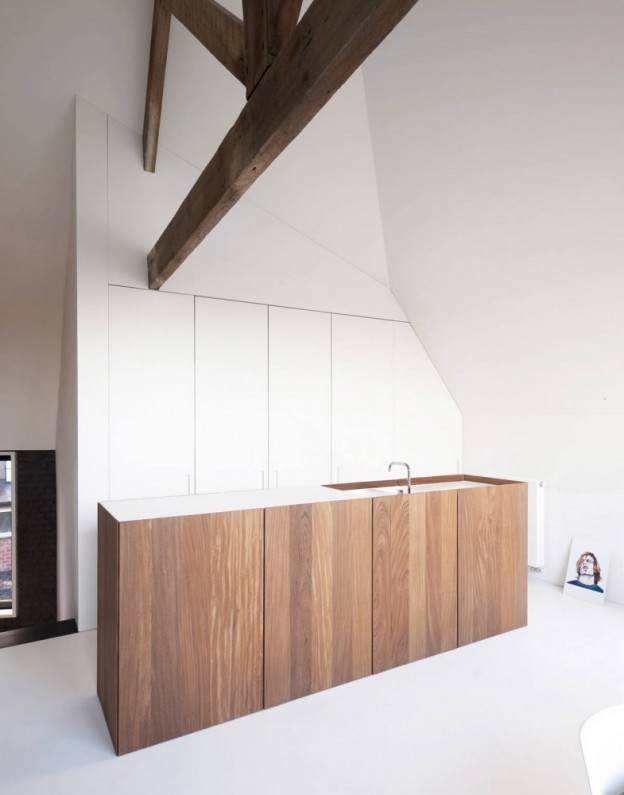
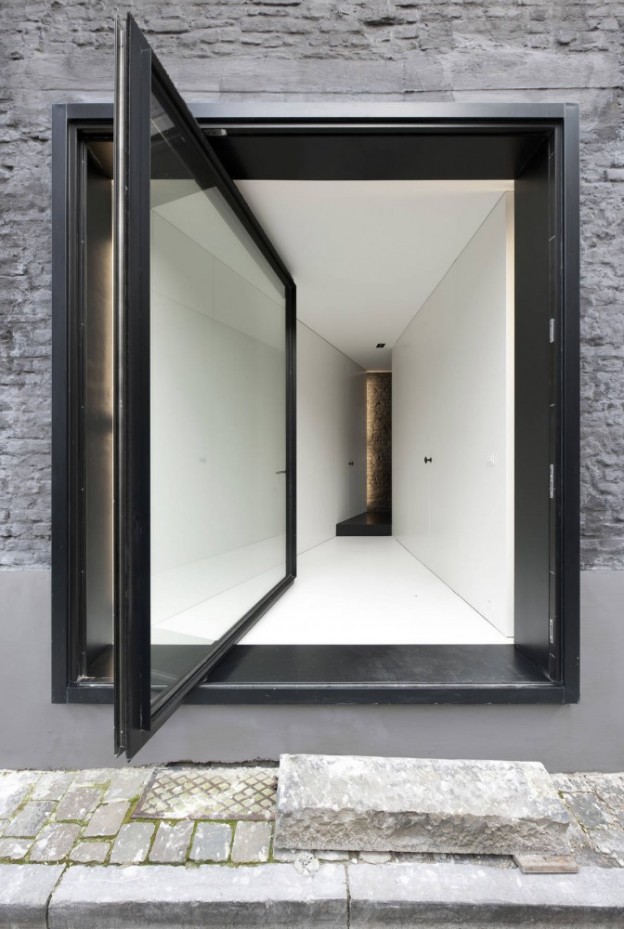
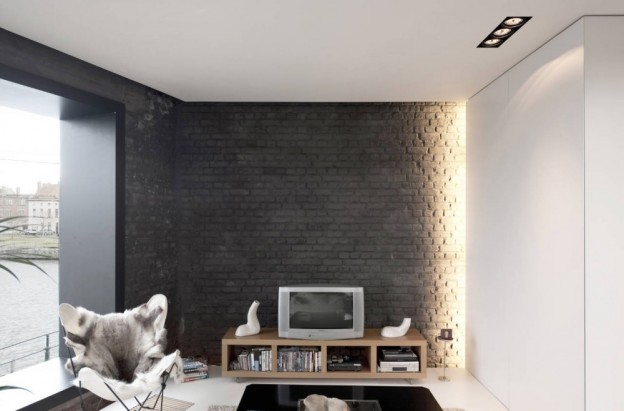
I discovered this house on Pinterest and had to investigate further. The beautifully framed views were the first thing that caught my eye; the cutouts with their wonderfully deep window reveals hint at the sheer thickness of the walls beneath. The next thing that captures the imagination is the restrained but dynamic palette of whitest white and blackest black, which offers the perfect backdrop to the soft, watercolour view beyond. An original brick wall is retained and painted dusky black, offering softness and texture to the otherwise crisp, smooth surfaces. The junctions between old and new float past each other and provide a slot where light is allowed to emanate from, or left in shadow. The palette of materials is kept minimal; a simple wood kitchen bar sits like a sculptural piece in the otherwise white space, with the rest of the kitchen concealed behind a white wall of doors.
1339549279-gba-house-g-s-luc-roymans-7-672x10001339549802-gba-house-g-s-luc-roymans-10-1000x6581339549819-gba-house-g-s-luc-roymans-12-717x10001339550008-gba-house-g-s-luc-roymans-16-785x10001339550088-gba-house-g-s-luc-roymans-19b-708x10001339550020-gba-house-g-s-luc-roymans-18-673x10001339549404-gba-house-g-s-luc-roymans-8-1000x6091339548936-mainimage-gba-house-g-s-luc-roymans-1-829x1000

This 19th century corner house is located on the waterfront overlooking the old city harbour docks of Ghent, Belgium. The original house was stripped back to facade, stairwell and roof truss. The rooms and living spaces are conceived as a ‘stack of volumes, a white sculpture inserted in the existing casing’. The functions of the house are inverted, with the bedrooms on the ground floor, the living areas above. The architects have aimed to create a ‘symbiosis between contemporary residential living and the charm of a 19th century Belgian corner house’.

I’d move in tomorrow, would you?

House G-S in Ghent, Belgium via Arch Daily

Photography, Luc Roymans

More wonderful spaces, here

gio ponti.

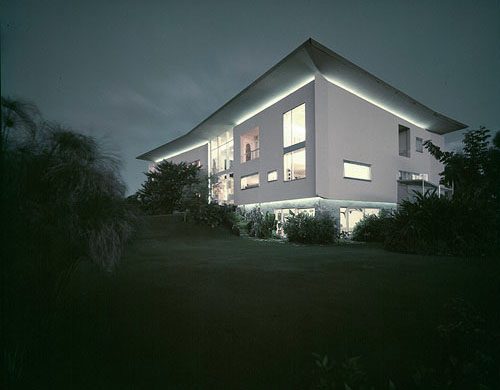
villa arreaza, caracus

Architect, craftsman, editor, writer, set designer and industrial designer. Founding editor of Domus magazine. Gio Ponti (1891-1979) has long been a design hero of mine, and how wonderfully relevant his designs are even today – all geometric patterns and blue-greys, and all imbued with exuberance and life.

Gio Ponti didn’t simply create buildings. He conceived the building’s interior as well, creating furniture, lighting, appliances, and ceramics, glassware, and silverware. Alice Rawsthorn in the NY Times called him a ‘designer of a thousand talents’ (read the review, here)

ponti furniture

Furniture images via

The Design Museum opened a wonderful exhibition of his work in 2002. Two quotes of his really resonated for me, as a mantra to follow and at the same time demonstrating his spirit and passion:

‘The architect must imagine for each window, a person at the sill, for each door a person passing through’.

‘Enchantment, a useless thing, but as indispensable as bread’.

Ponti originally trained as an architect and entered industrial design by developing products for Richard Ginori, an 18th-century ceramics manufacturer in Florence, for whom he later became artistic director. As an architect, Ponti’s designs embodied and embraced every era in which he worked. The classical style of his earliest houses in the 1920s, evident also in his designs for Ginori, were heavily influenced by Andrea Palladio’s 16th-century villas. In the forties he designed costumes and sets for the opera and ballet, as well as gleaming chrome espressomakers for La Pavoni. He also started another magazine, Stile. After the war he helped rejuvenate Italian ship travel with a commission to fit out four ocean liners. In the fifties his collaborations with Piero Fornasetti resulted in a series of surreally beautiful residences in Milan. In addition he built the iconic, modernist skyscraper, the Pirelli Tower (1956) in Milan, the Villa Planchart (1953-57) and the Villa Arreaza (1956) in Caracas, Venezuela, which are among the most exquisite houses of the modernist period. There is a wonderful article written by Ponti himself describing the Villa Planchart and his design process, in an archival issue of Domus (read it, here).

planchart01dailyicon

ponti02dailyiconponti01dailyicon

arreaza4

Images of Villa Planchart via Gio Ponti archive and Daily Icon

Ponti used his writing and editorial roles to champion designers and artists whom he admired, including Carlo Mollino, Piero Fornasetti and Lucio Fontana, and in the process contextualised Italian design within contemporary culture. He always encouraged young designers, even when they challenged his own thinking. Among them were Alessandro Mendini and Ettore Sottsass, who were at the forefront of the 1970s post-modernist movement, which emerged as an alternative to modernism.

‘It is neither necessary to be a dogmatic follower of modern design or a dogmatic follower of traditional design to be modern and traditional, nor even to be preoccupied with all of this’.

More design heros, here

the list: what to see in 2013.

A look forward to some exciting exhibitions and talks coming up in London in the first half of 2013:

jeurgen teller

1. Juergen Teller: Woo

23 January – 17 March 2013

A journey through his landmark fashion and commercial photography from the 90s, presenting classic images of celebrities such as Lily Cole, Kate Moss and Vivienne Westwood, as well as more recent landscapes. Juergen Teller is one of few photographers to operate in both the art world and at the centre of the commercial sphere, working with Marc Jacobs and Celine, among others.

Institute of Contemporary Arts

tim walker

2. Tim Walker: Story Teller

Until 27 January 2013

Extravagant in scale and ambition and instantly recognisable, Tim Walker’s photographs are full of life, colour and humour.

3. Valentino: Master of Couture

Until 3 March 2013

Celebrating the life and work of one of fashion’s most inspirational and influential designers. A lovely review on A Nomadic Abode, here

both, Somerset House 

steilineset memorial

4. Santiago Calatrava, RIBA lecture series, Tuesday 29 January, 7pm

5. Peter Zumthor, RIBA lecture series, Tuesday 05 February, 6:30pm

6. Emerging Architecture

Until 21 February 2013

The exhibition features award winning projects covering buildings, interiors, product design, engineering structures, urbanism and landscape – architecture’s emerging generation from 2012.

7

7. Mariko Mori: Rebirth

Until 17 February 2013

Japanese artist Mariko Mori’s first major exhibition in London for 14 years, including some of Mori’s most acclaimed works from the last 11 years, alongside new works created especially for the exhibition. Read the Guardian review, here

Royal Academy of Arts

whaam

8. Lichtenstein: A Retrospective

21 February – 27 May 2013

The first full-scale retrospective of this artist in over twenty years.

Tate Modern

9. David Bowie Retrospective

23 March – 28 July 2013

Guardian review, here

Victoria & Albert Museum

10. Chromazone: Colour in Contemporary Architecture

Until 19 May 2013

Featuring key projects by major UK and international architects who use colour to create identity and define space in an attenpt to heighten the user experience of a building.

Victoria & Albert Museum

patrick caulfield

11. Patrick Caulfield and Gary Hume

5 June – 1 September 2013

A focused selection of work by Gary Hume (born 1962), in parallel with British painter Patrick Caulfield (1935–2005), illuminating the comparable work of these two artists from different generations.

Tate Britain

This is my pick of exhibitions and talks to look forward to; I’d love to know your thoughts!

a modern house.

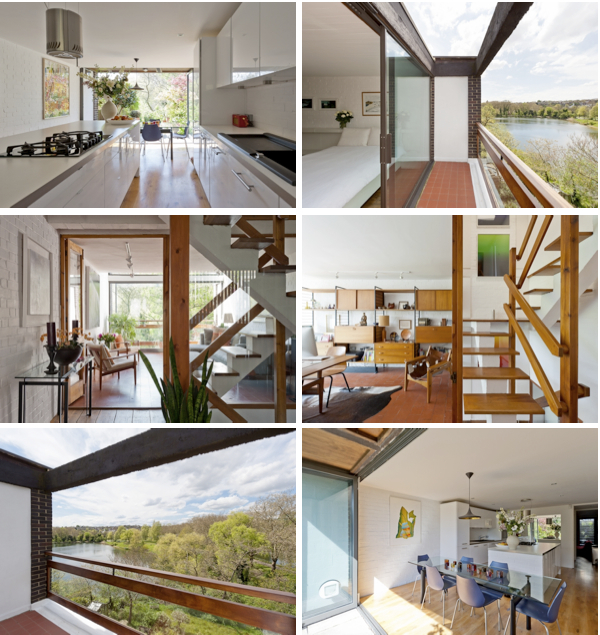
In a very lovely part of North London, not far from home, is this house. It is properly modern –  built in the mid 1950s by the architects Howell and Amis. It is one of six built as a terrace, there is a shared orchard and its back garden is the wonderfully wild but utterly civilised Hampstead Heath.

The layout is over four storeys. Being a terrace it is narrow – a smidgen over 3.5 metres wide. But every level has full-width floor-to-ceiling glazing across the rear elevation, providing wonderful framed views of Hampstead Ponds and lots of natural light. The interior palette is simple, with white washed walls, wood and terracotta tiled floors, and an open tread timber stair forming a spine through the floors. I’ve already interior-decorated it in my mind.

And best of all it’s for sale! Now, about that price tag…

All images The Modern House

lina bo bardi.

Lina Bo Bardi (1914-1992) was an Italian architect who moved to Brazil in 1946. Her work is in the spotlight right now, with a current exhibition at the British Council in London (until 30 November), and a seminar at the ICA on the 10 November. The Architecture Association mounted an exhibition earlier this year of her work along with that of her ex-boss (another design hero of mine), Giò Ponti.

Bo Bardi was a modernist in her use of simple forms, concrete and glass, but rather than making the grand gestures of her contemporaries (Mies van der Rohe, Philip Johnson amongst others) she embraced the traditional cultures of her adopted country Brazil in her very contextual, playful buildings. Her work is more organic, informed out of a response to its inhabitants and environment, rather than being simply a ‘machine for living’. Her work is characterized by a celebration of the everyday and the ordinary.

Social concern did not, for her, mean she had to be sentimental, but that her professional skills should be applied to spaces available to everyone. Herman Hertzberger is another proponent of this approach: both aim for a balance of content and form.

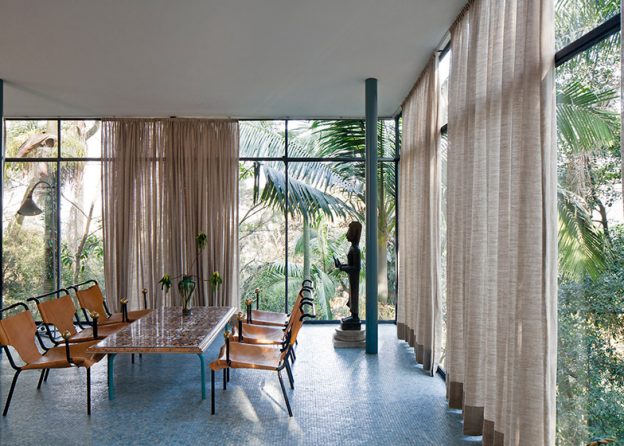
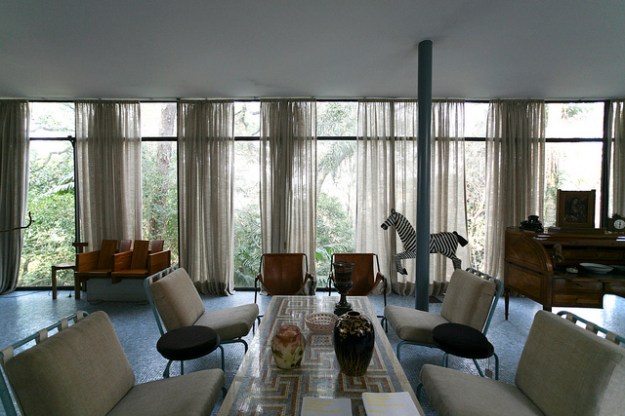
She designed private homes including her own, the Glass House in Sao Paolo (1951, now the Instituto Lina Bo e P.M. Bardi), an early example of the use of reinforced concrete in domestic architecture. It is a beautiful, simple form, a glass box sitting atop long thin posts, allowing the landscape to flow beneath. It is integral with its environment.

Bardi designed modern furniture in plywood and native Brazilian woods; she believed that every designed object ought to take on a form that would display its own ‘natural logic’.

The Museum of Art in Sao Paolo (1957-68), perhaps her most famous building, is a monumental but very humane building. Her solution to the hillside setting was to arrange the building in two parts, one raised up on enormous concrete columns, the other half-buried. This created a third space, the void between the two, which was the ‘belvedere’: a meeting place for work and play; an open arena for gatherings, exhibitions and festivals. For the interior the paintings were removed from the walls instead supported by freestanding glass ‘easels’ sunk into concrete, accompanied by seemingly floating sculptures on transparent blocks.

Her other main civic building, the SESC leisure centre in Sao Paolo, is an example of her desire to create democratic spaces. A conversion of an old factory, she did not try to hide the building’s origins, as it spoke of its location in a working class area of Brazil. ‘It achieves things often hoped for, such as the co-existence of high and low culture, chess, football and ballet, of old and young, of ambitious architecture and the everyday’ (Rowan Moore, The Observer, Sunday 9 September 2012)

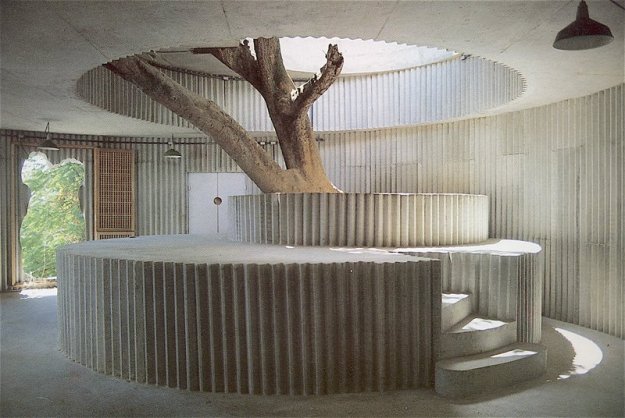
Coati resturant & bar, Ladeira da Misericórdia, 1987 via

Interior of Bo Bardi’s Glass House, Sao Paolo, 1951 via

Feature image: Interior of Bo Bardi’s Glass House, Sao Paolo, 1951 via